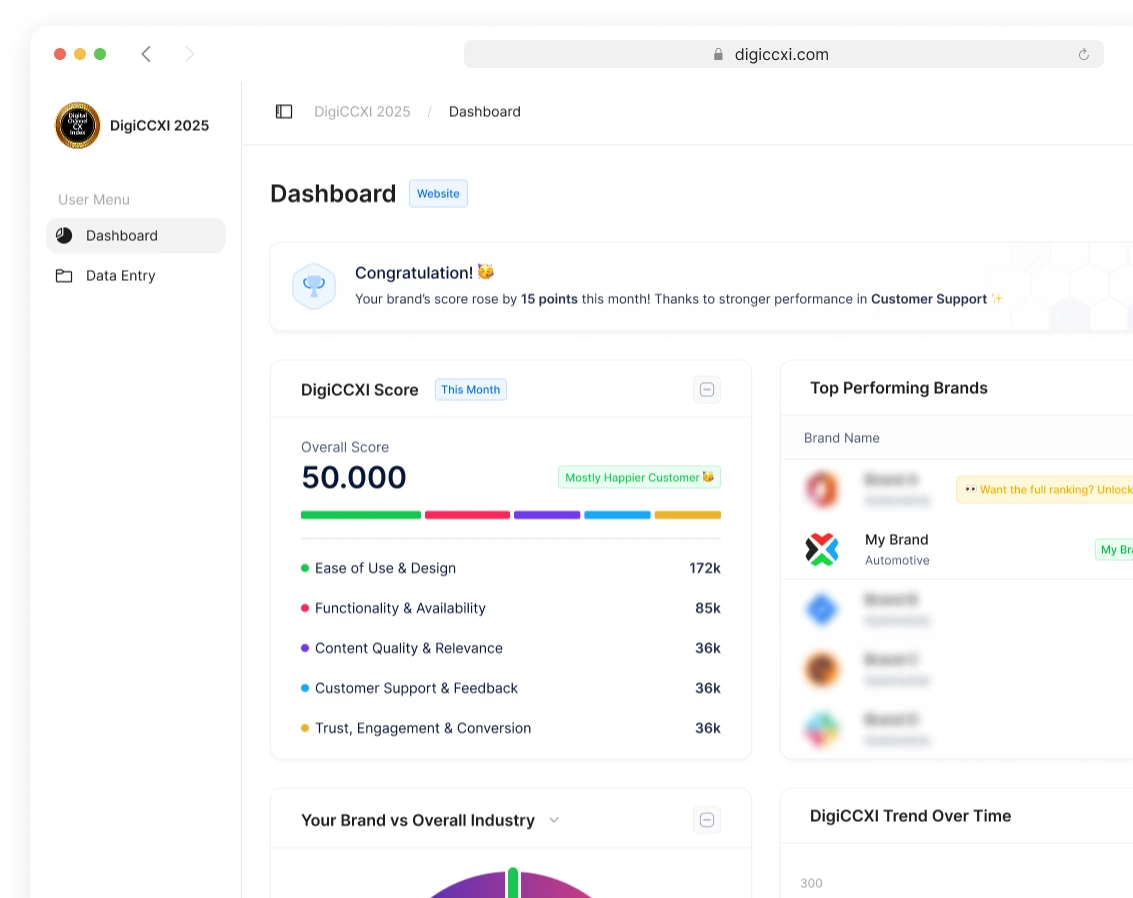

A Unified Framework to Evaluate App & Web Customer Experience
Using weighted dimensions—from accessibility and reliability to content relevance and conversion—DigiCCXI quantifies the end-to-end digital journey. Benchmark your Mobile App and Website against industry standards and identify what drives satisfaction and engagement.
For Mobile Apps
Objective: To evaluate the overall user experience (CX, UX, and UI) from the customer’s perspective while interacting with mobile applications.
Scoring & Indexing: Each dimension is scored on a 0–100 scale based on pre-defined KPIs. The final DIGICCXI score is computed using a weighted average, aligning with the relative importance of each dimension.
Key Dimensions & Weightings

Ease of access and intuitive navigation through the app.
Feasibility App availability, compatibility with devices and OS.
Navigation Logical flow and ease of locating functions.
Ease of access and intuitive navigation through the app.
Feasibility App availability, compatibility with devices and OS.
Navigation Logical flow and ease of locating functions.
Ease of access and intuitive navigation through the app.
Feasibility App availability, compatibility with devices and OS.
Navigation Logical flow and ease of locating functions.
Ease of access and intuitive navigation through the app.
Feasibility App availability, compatibility with devices and OS.
Navigation Logical flow and ease of locating functions.
Ease of access and intuitive navigation through the app.
Feasibility App availability, compatibility with devices and OS.
Navigation Logical flow and ease of locating functions.
Data Collection Methods
DigiCCXI collects mobile app insights through user perception surveys, in-app analytics, usability testing, heatmaps, and app store review analysis—capturing real behavior, satisfaction, and technical performance from actual users.

Remote or in-person usability tests that reveal how easily users can complete tasks.
E.g., post-session or quarterly feedback on usability and satisfaction.
Remote or in-person usability tests that reveal how easily users can complete tasks.
Tracking behavior using platforms like Firebase, Mixpanel, or Amplitude.
Remote or in-person usability tests that reveal how easily users can complete tasks.
Observational studies to assess navigation patterns, drop-off points.
Remote or in-person usability tests that reveal how easily users can complete tasks.
Sentiment analysis from public app reviews to identify key themes.
For Websites
Objective: To evaluate the complete digital customer experience on a brand’s website by examining interface design, functional performance, trust signals, support accessibility, and user engagement. The goal is to uncover actionable insights that improve satisfaction and drive stronger conversion.
Scoring & Indexing: Each factor is evaluated against a scoring rubric with benchmarks. A weighted average forms the final index score (0-100), where higher scores represent better digital experience.
Key Dimensions & Weightings
UI intuitiveness and navigation
Mobile responsiveness
WCAG 2.1 accessibility compliance
Ease of access and intuitive navigation through the app.
Feasibility App availability, compatibility with devices and OS.
Navigation Logical flow and ease of locating functions.
Ease of access and intuitive navigation through the app.
Feasibility App availability, compatibility with devices and OS.
Navigation Logical flow and ease of locating functions.
Ease of access and intuitive navigation through the app.
Feasibility App availability, compatibility with devices and OS.
Navigation Logical flow and ease of locating functions.
Ease of access and intuitive navigation through the app.
Feasibility App availability, compatibility with devices and OS.
Navigation Logical flow and ease of locating functions.
Data Collection Methods
DigiCCXI collects mobile app insights through user perception surveys, in-app analytics, usability testing, heatmaps, and app store review analysis—capturing real behavior, satisfaction, and technical performance from actual users.
Perception User Surveys
E.g., post-session or quarterly feedback on usability and satisfaction.
Web Analytics
Remote or in-person usability tests that reveal how easily users can complete tasks.
UX Testing
Remote or in-person usability tests that reveal how easily users can complete tasks.
Session Recordings
Replay of real user sessions to visualize scrolling patterns, clicks, hesitation points, etc.
Social Media & Online Review Monitoring
Tracking public comments, user posts, and external reviews to identify sentiment trends, etc.